

The food and beverage industry's first reaction to GLP-1 was to look at volume. Less appetite could mean less in the grocery cart, fewer orders at the table and, taken far enough, whole categories shrinking.
That conversation still matters. It just starts with a question that may be arriving too early. Before we know how much people will stop consuming, there's a shift already underway worth looking at: what earns its place when there's less room to eat.
With appetite down, every food choice carries more weight. That's the context where fiber, whey protein, portion control and meal planning start to mean something different.
GLP-1 was always going to change how people eat. The question is how
Winnin Intelligence data shows that 40% of all engagement around GLP-1 now happens outside healthcare, spread across beauty, finance, wellness and food. Within that spillover, food and beverage is the largest block after medicine, holding 19,4% of the topic's engagement.
Food showing up here isn't surprising on its own. A drug that interferes with appetite is going to change how people relate to eating. What matters is what starts to move from there.
1. Eating less is creating new gaps to fill
The first consequence of a smaller plate isn't simply consuming less. It's deciding what can't be left out. When there's less room to eat, nutrients and functions that used to spread across bigger meals now compete for a smaller share of food.
That's where part of the supplement category takes on a new job, and the data shows a clear reshuffle in that territory. Not one of the eight positions stayed where it was.
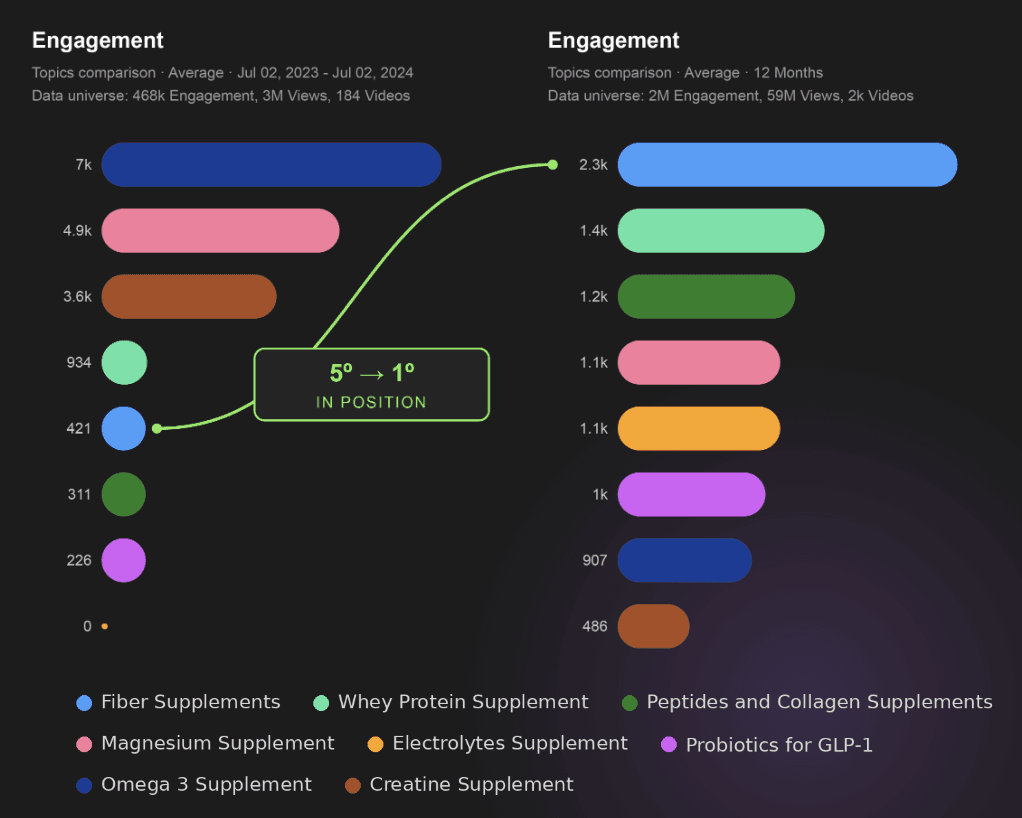
There's a detail in that movement worth pausing on: the universe analyzed went from 184 videos to 2,000. With far more content entering the territory, holding or growing average engagement gets harder, not easier. Fiber and whey grew anyway.
The ranking doesn't explain on its own why this happened, but it does show which needs are pulling the most attention as GLP-1 settles into people's routines. Fiber speaks directly to gut issues. Whey answers a concern about protein and lean mass. Electrolytes sit next to hydration.
These are specific needs, and that's the part that matters. Because none of them has to be solved inside the supplement aisle. For food and beverage companies, the signal is in the need behind the product. If protein, fiber or hydration become things people feel they have to secure within a smaller intake, products from very different categories can end up competing for the same space.
Fiber is a particularly interesting case. It can answer a need tied to treatment, but it also speaks to a broader concern with health and eating. Which opens the possibility that part of that demand reaches well beyond GLP-1 users.
For the industry, the useful move is to look past the "GLP-1" label and at the needs underneath it. Which of them can your category already solve, and which ones are only now becoming visible?
2. Quantity stopped being a detail
For years, the portion discussion sat mostly with diets, calories and control. The reference points have moved. Portion controlling, which held third place in average engagement among the eating behaviors tracked, took the lead — from 13k to 23.8k.
Over the same period, low carb dropped from 22.5k to 12k, and calorie counting went from 13.6k to 8.8k. Video volume stayed roughly flat, 59k against 58k. So the shift is happening inside the territory itself, not because more content arrived.
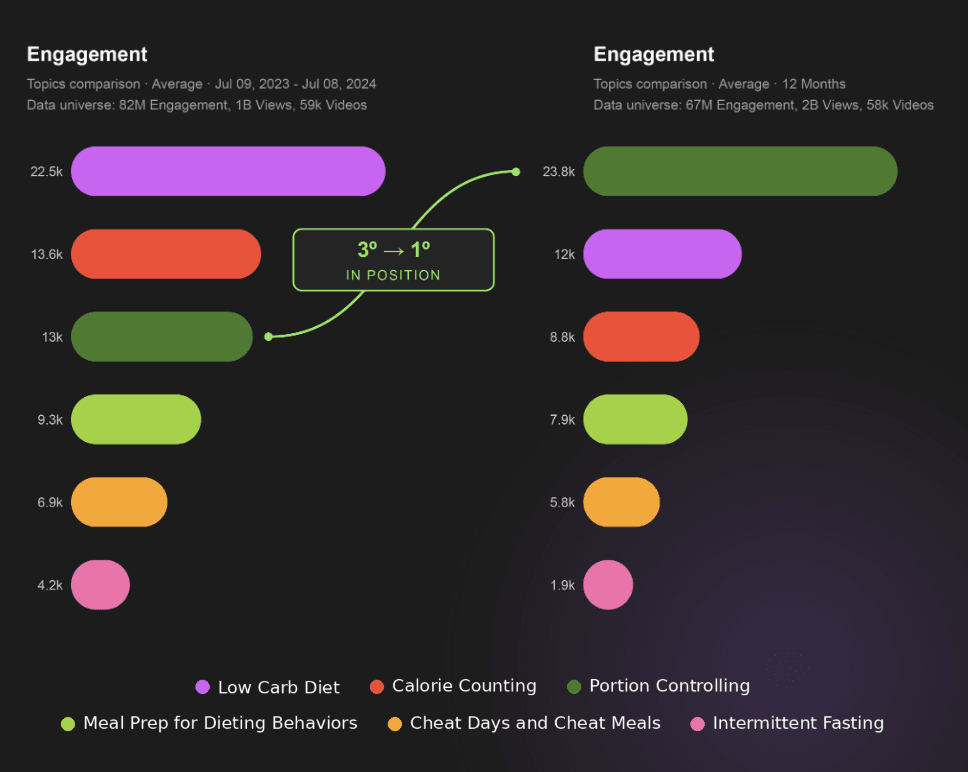
For some GLP-1 users, that helps explain why portion carries a different weight now. Controlling how much you eat has always been a decision you could make. When appetite drops, how much fits in a meal can become a practical limit instead.
Ordering a smaller plate, splitting a dish or taking the rest home stops being a diet tactic and becomes part of the consumption experience. And when quantity changes, more changes than the nutrition panel.
What's left over changes. So does the chance of waste, and how a product needs to be stored. So does the fit between the size of what's offered and what a person can actually finish.
That's a product question, not just a communications one. For food and beverage companies, the point isn't that every brand needs to launch smaller versions — the data doesn't support that claim. What it does support is a question worth asking: was the current portfolio designed for someone who eats the same amount they used to?
Size, packaging, the option to split consumption and how something keeps once opened can all carry different weight inside this new routine.
3. Convenience may be starting to mean something else
GLP-1 didn't invent meal planning. It didn't invent interest in high-protein meals or gut health either. But those behaviors are showing up together, inside a routine that demands more attention to food.
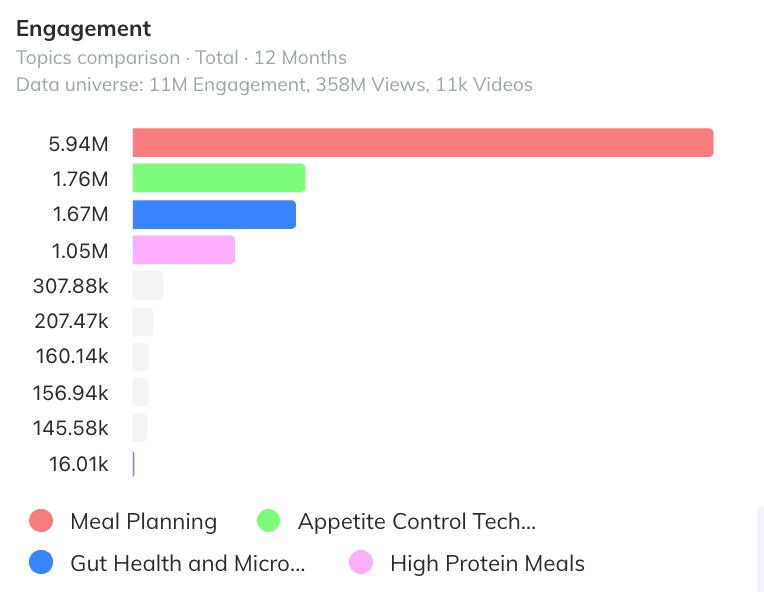
This doesn't mean GLP-1 turned everyone into a meal planner. It means that within this territory, planning has gained weight. Which tracks: if someone is trying to secure protein, fiber and other nutrients inside a smaller amount of food, improvising every meal takes more effort, not less.
That's where convenience picks up another layer. Traditionally, a convenient product is one that saves time: ready to go, fast, barely any prep. In this routine, convenience can also mean cutting down the effort of deciding what to eat and making that intake work.
The opportunity here goes past building "GLP-1 friendly" products. For food and beverage, it may sit in formats, products and services that make an eating routine simpler now that it takes more planning. The question is how to make it easier for someone to get what they need.
What these movements reveal for food and beverage brands
Fiber leading a new supplement territory. Portion control pulling attention. Meal planning becoming the biggest non-medical consumption occasion in this universe.
The data doesn't show three isolated trends. It shows different behaviors responding to the same context: a relationship with food where each choice may need to deliver more.
None of this means people stopped choosing food for pleasure, convenience or price, or that every product is now judged on its nutrients alone. But for the people living through this shift, new needs are competing for space. That's where the sharper questions for the industry start.
Where does your category sit when a need cuts across products? Fiber shows up in supplements, in food and in drinks. So does protein. When demand sits with the need rather than the category, the competitive set can change. A brand may be competing for attention not only with similar products, but with anything that promises to solve the same problem.
Was your product designed for the new consumption experience? If the amount consumed changes, size and format stop being purely operational calls. There's no single answer across categories, but there is a shift worth watching: what worked for a routine built on higher volume may not work the same way once that volume drops.
Does convenience still mean speed alone? The meal planning data points to growing demand for organizing food within this territory. For some companies, that opens room to think about convenience differently — not only saving minutes of prep, but removing decisions, simplifying combinations and helping people build an eating routine that fits what they need.
The demand space isn't limited to GLP-1 users
The risk for the industry is treating GLP-1 as one more audience to segment. The data points to something wider. The shift the drug set off is making certain needs more visible. Some belong squarely to the treatment experience. Others can travel well past that base and gain relevance in a bigger discussion about food, health and the body.
Fiber is a good example. Its growth inside this territory doesn't mean the category exists because of the medication. It means a need found a new context, and with it, new attention.
For food and beverage companies, the work is finding where these behaviors connect to something your category can already deliver. Because the demand space isn't necessarily in building "the next GLP-1 product." It's in understanding which problem this new routine made visible — and who has the Right to Win to solve it.
Go deeper into the GLP-1 Demand Map
In our new Cultural Intelligence Report, we read the post-weight-loss-pen consumption shift through demand intelligence. Winnin Intelligence data measures attention — what people choose to watch, engage with and spend time on. That's what makes it possible to spot behavioral shifts while they're still reorganizing a territory, which is exactly where new demand spaces start to surface.
The full GLP-1 cut is in the GLP-1 Demand Map. Download it here.