

"Ozempic face" entered the vocabulary as a side effect. The name already framed it as something unwanted, something to fix. But what was labeled a consequence is already creating demand.
Behavioral data tells a bigger story: GLP-1 is creating new beauty needs and, with them, new demand spaces for brands looking to position themselves ahead of the competition.
GLP-1 has moved from treatment to routine
Winnin Intelligence data shows that video volume around GLP-1 analogs has grown 96% over the past two years. Engagement is up 42%, and views have increased 38%.
But scale matters less than the direction of the movement. Half of all engagement is already concentrated on benefits beyond the drug's original indication. Primarily metabolic, focused on the treatment of type 2 diabetes.
Aesthetics is now the third-largest engagement cluster among the benefits driving people toward GLP-1.
And what happens when a treatment leaves the doctor's office and becomes part of everyday life? It reorganizes behavior around the new needs the medication creates.
That is where beauty stops being a spectator and becomes part of the conversation.
Half of the pain points mapped around GLP-1 are about beauty and self-esteem
The conversation around GLP-1s is reaching the beauty routine through several unintended consequences. Winnin mapped the ten pain points driving the highest average and total engagement around GLP-1 and five are directly related to appearance and self-image: skin aging and collagen loss, facial volume loss, hair loss management, muscle preservation, and beauty standards.
And this behavior extends beyond people taking the drug. The data shows that attention to aesthetic procedures, including Botox, face lifts, lymphatic drainage, and plastic surgery, rises during the same periods when attention to GLP-1 increases. Beauty is already part of this movement, not adjacent to it.
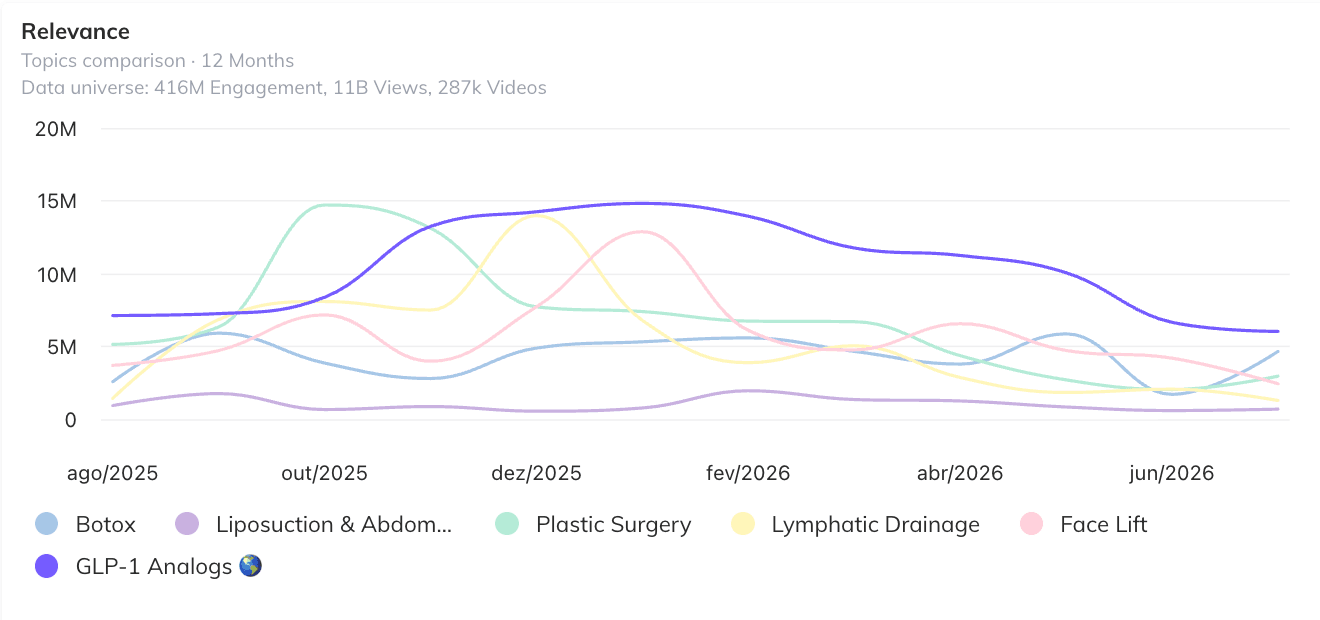
Source: Winnin Intelligence. Last 12 months. Content produced on TikTok, Instagram, YouTube, Facebook, and Twitch. Global.
Shift 1: weight is coming off faster than skin can keep up
Facial fat loss is one of the fastest visible consequences of rapid weight loss. It can show up as sagging, wrinkles, and a prematurely aged appearance. Something the feed has dubbed "Ozempic face."
The effect doesn't stop at the face. Silicone implants are getting smaller, BBLs are being reversed, and "Ozempic butt" has entered the vocabulary.
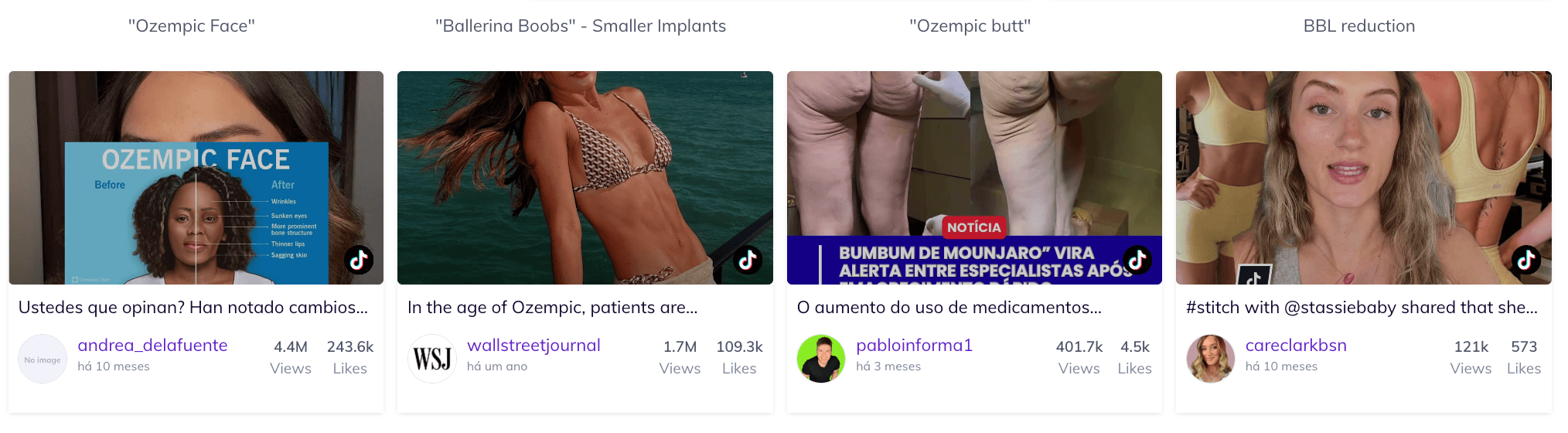
What is happening goes beyond a shift in aesthetic preference. It is another disruption to established beauty standards.
Behavior is following suit. Over the past two years, plastic surgery led average engagement among the procedures analyzed, at 113K, compared with 76K for face lifts.
Over the last six months, the order flipped: face lifts took the lead at 28K, followed by Botox at 27K, while plastic surgery fell to 25K.
What this means for the industry?
The market is already shifting toward faster, less invasive corrections that can keep pace with the speed of weight loss.
As beauty standards move at the same speed as body transformation, consistently reading audience needs stops being a research refinement and becomes an operating requirement. A portfolio calibrated for the pace of natural aging is running on a clock this audience is no longer keeping.
Source: Winnin Intelligence. Content produced on TikTok, Instagram, YouTube, Facebook, and Twitch. Global.
Shift 2: prevention is becoming part of the protocol
The GLP-1 community is behaving in a way other categories already know well: it moves early.
Before an effect even appears, users are already assembling a support arsenal around the treatment.
That is already visible in skin-related content. Peptides combined with skincare account for 55% of content share and 73M engagements over the past year. Collagen biostimulators follow at 30% share.
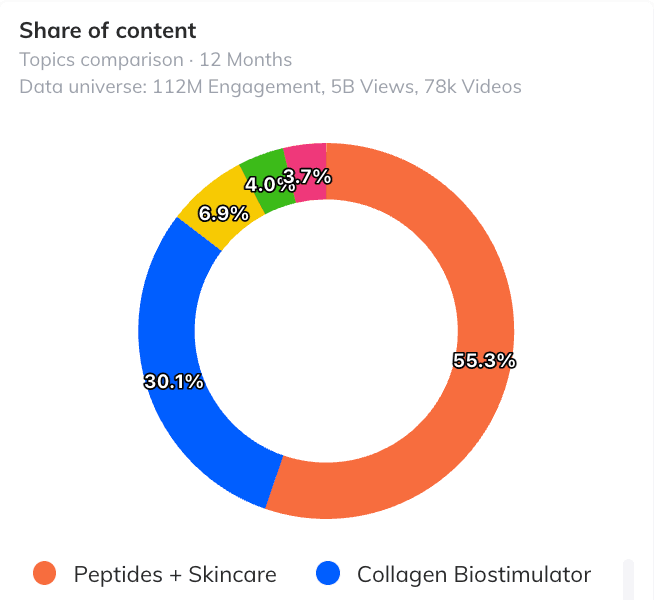
The pattern matters more than the numbers: this is a community focused on preventing the effects of weight loss, not simply repairing them once they appear.
What this means for the industry?
Brands that enter the routine early can become part of the treatment, rather than a correction to it.
It is a difference in positioning, not product. Arrive after the effect appears and you compete for the repair job. Arrive before it and you become part of the protocol, moving beyond one-off purchase logic.
Source: Winnin Intelligence. Last 12 months. Content produced on TikTok, Instagram, YouTube, Facebook, and Twitch. Global.
Shift 3: not every side effect gets the same spotlight
Hair loss circulates openly as a known GLP-1 side effect: it has video volume, search interest, and increasingly, treatment. Bad breath, another documented effect, behaves in the opposite way.
It is the pain point with the highest average engagement among the ten mapped, while also having the lowest total engagement. High intensity concentrated in a small audience. In other words, there is an audience. It just doesn't want to be seen.
And when behavior doesn't show up at scale, it doesn't necessarily disappear. It can move into more private spaces that are harder to track.
What this means for the industry?
The less visible a side effect is, the more room there may be for a brand to be first to address it.
Low volume is often interpreted as low demand. Here, the opposite may be true: concentrated demand with no clear category response.
Source: Winnin Intelligence. Last 12 months. Content produced on TikTok, Instagram, YouTube, Facebook, and Twitch. Global.
The GLP-1 Demand Map reveals the bigger picture
This is just one of the demand spaces GLP-1 has opened. The GLP-1 Demand Map, Winnin's new Cultural Intelligence Report, maps other demand spaces across categories and shows how this behavior shifts depending on local context.
In the US, weight loss is first and foremost a food conversation. In Brazil, it goes hand in hand with exercise. In Mexico, the aesthetic consequences stand out above average.
The same demand does not manifest the same way across markets.
For brands operating globally, understanding that context can be the difference between adapting a campaign and identifying an opportunity before it becomes obvious.