Beauty brands have already figured out that major sports events are a massive opportunity. Dove is sponsoring the 2026 World Cup. Kaiak is activating at the World Surf League. Hello Kitty took over the F1 Academy paddock. So the question isn't "should we be in sports?" anymore — it's where exactly are you earning relevance, and with whom.
Winnin's Cultural Intelligence Report "The New Era of Sports Fandom" dug into over 8 million videos, 430 billion views, and 21 billion engagements across global sports events over the past three years — all to pinpoint where attention actually lives.
Here's what became clear: the game itself is only part of the story. To win in this space, brands need cultural intelligence — the ability to turn culture, fandom, and attention into a real competitive advantage at the world's biggest sports moments.
And what the data shows goes way beyond "beauty and sports overlap." It reveals how that overlap works, when it explodes, and what's really driving it.
Beauty isn't on the sidelines of sports culture. It's in the thick of it.
Behavioral data from online video consumption makes one thing obvious: people are already connecting beauty and sports on their own. The content is there. The engagement is there. The question is whether brands are meeting that moment with real intelligence — or just showing up.
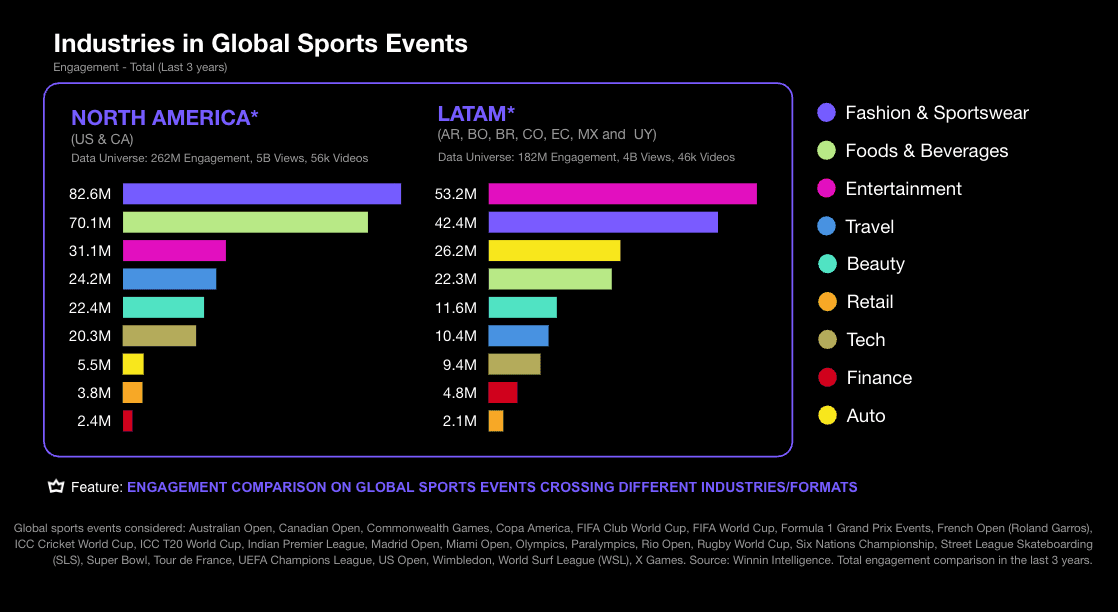
The numbers back this up. In North America, Fashion & Sportswear leads all industries in engagement at global sports events, averaging 82.6M. Foods & Beverages is right behind at 70.1M. Beauty comes in 4th — ahead of Travel, Tech, Auto, and Retail. In Latin America, Beauty ranks 5th with 11.6M engagements.
What's driving this audience has nothing to do with the scoreboard.
Winnin's data points to a pattern that keeps showing up: the biggest beauty engagement spikes in sports contexts don't line up with game schedules. They line up with moments where sports and identity crash into each other.
In July 2024, beauty engagement in global sports contexts hit nearly 6 million — the highest point in a 2 years analysis period. The catalyst? Olympic rugby player Ilona Maher going viral after speaking out about not having to sacrifice her femininity to be an athlete. That statement set off a wave of content about identity, representation, and self-expression in sports — and beauty was right in the middle of it.
That's the real opportunity: not the event itself, but the cultural conversation it sparks — or the one happening right around it.
The audience you're probably not fully accounting for
Men and women are equally engaged when beauty and sports collide. The beauty audience at global sports events splits 50% female, 50% male — and the biggest age group is 25–34, followed by 18–24 and 35–44.
This is a balanced, young, culturally plugged-in audience that doesn't see sports and beauty as separate worlds. They never did. Getting that right is what separates brands doing generic activations from brands actually in the conversation.
Three moves defining this space right now
#1 — Athletes are style icons now. Full stop.
The way athletes show up off the field has become just as important as what they do on it. Tunnel walks are fashion moments. Grooming partnerships are headline news. Self-care is part of the athlete story. Performance and aesthetics aren't separate anymore — and that's made sports one of the most powerful forces in fashion and personal care today.
Content around athletes as aesthetic references is already happening at massive scale. Brands that show up here naturally are capturing attention that no ad buy can replicate.
#2 — The game is becoming a creative brief for beauty.
Team colors on nails. Athlete-inspired hairstyles. Makeup looks built around competition aesthetics. Sports imagery is bleeding into beauty in ways that are organic, creative, and consumer-led — not brand-driven.
Sports has locked in as a visual language — one that turns energy, belonging, and identity into aesthetic expression. Brands that get this make products and campaigns that feel like a natural part of that language. The ones that don't just interrupt it.
#3 — The 2026 World Cup already has an aesthetic — and it's 2016.
The tournament hasn't started, and beauty is already moving. Beauty Trends for World Cup 2026 is the second-largest niche in both views (32.8%) and engagement (19.2%) in the beauty and global sports events universe.
And the cultural signal coming through loud and clear is nostalgia for 2016. Fashion communities and fans alike are already referencing the visual codes of that year. Bold makeup, saturated colors, specific aesthetic references from that era — all of it could define campaigns and product launches in 2026, turning nostalgia into the season's biggest style trend.
Passion Fusion: when two fandoms collide, both win
In a year as loaded with sports moments as 2026, the brands that stay culturally relevant will be the ones who understand where their world and the sports world actually overlap.
That's what makes Passion Fusion — a phenomenon Winnin identifies in the Cultural Intelligence Report — so important. It's what happens when two distinct fandoms merge: new content gets created, new audiences get reached, and both sides grow. Soccer x Anime. F1 x Fortnite. Rugby x Beauty.
Brands that understand this stop activating around the event and start activating inside the culture the event generates. That's the difference between being present and being relevant.
What's already working in the real world
Dove Men+Care | FIFA World Cup 2026: Limited-edition deodorants and antiperspirants with World Cup-inspired packaging, plus QR codes that pull consumers directly into the competition experience. It connects care, confidence, and performance to the biggest sporting event on the planet — and does it with more than just a logo.
Kaiak | World Surf League: On-site activations at Vivo Rio Pro in Saquarema, with fragrance sampling and immersive experiences that bring people into the world of surf. It works because Kaiak's identity — freshness, nature, the ocean — is already what the WSL represents. Nothing forced.
Hello Kitty | F1 Academy: Themed merch, decorated grandstands, interactive experiences — all around a single event, the Las Vegas Grand Prix. The result: over 144 videos and more than 1 million engagements. Pop culture, fashion, and beauty audiences showed up for motorsport in a way they never had before.
The thread running through all three: cultural coherence. Each brand found a genuine connection between who they are and what the event means — and built from there.
Where most brands are still leaving attention behind
Beauty Routines and Products accounts for 78.6% of content and 75.9% of engagement in the beauty and global sports events space. It's the foundation — but it's also where everyone is competing, and where things get most generic.
The real white space is in the niches that are gaining ground: aesthetic trends tied to specific events, conversations about identity and representation, content born from the collision of different passions. That's where attention is forming before it goes mainstream.
3 questions worth asking before your next activation
Before the old sports marketing playbook goes back into rotation, it's worth pressure-testing it against what the cultural landscape actually looks like right now.
Is your connection to the event real — or is it just a logo placement?
The biggest engagement spikes happen when brands become part of the event's cultural narrative, not when they just appear in it.
Are you timing it right?
Major competitions compress attention into very specific windows. And the data on Beauty Trends for World Cup 2026 already shows that window is open — long before the first whistle.
Do you actually know who you're talking to?
A 50/50 male-female audience, mostly 25–44, that blends genuine sports passion with real interest in care and aesthetics. That's not a niche. That's a wide-open audience waiting for content that speaks their language.
This article is based on data from Winnin's Cultural Intelligence Report "The New Era of Sports Fandom," which analyzed over 8 million videos, 430 billion views, and 21 billion engagements across global sports events over the last three years, covering LATAM, North America, Europe, and APAC.
Want the full report? Download here →