

Latin culture is no longer just crossing borders. It's opening new demand spaces. Over the past 12 months, content tied to it generated 73% more engagement outside Latin America than inside it, according to Latin Fever, Winnin's latest Cultural Intelligence Report.
For marketers, the story isn't the engagement itself. It's the demand behind it. As Latin culture expands globally, brands have an opportunity to identify where that demand is emerging, and act before competitors do.
Download Latin Fever for free here. The full Cultural Intelligence Report breaks this map down by region, category, age, and gender, along with more case studies that didn't make it into this piece.
Latin Culture Doesn't Follow the Map of Latin America
One of the report's clearest findings challenges a long-held marketing assumption: cultural proximity doesn't follow regional borders. Mexico, for example, behaves more like the United States than like Brazil, despite both countries being grouped under the same "Latin America" label.
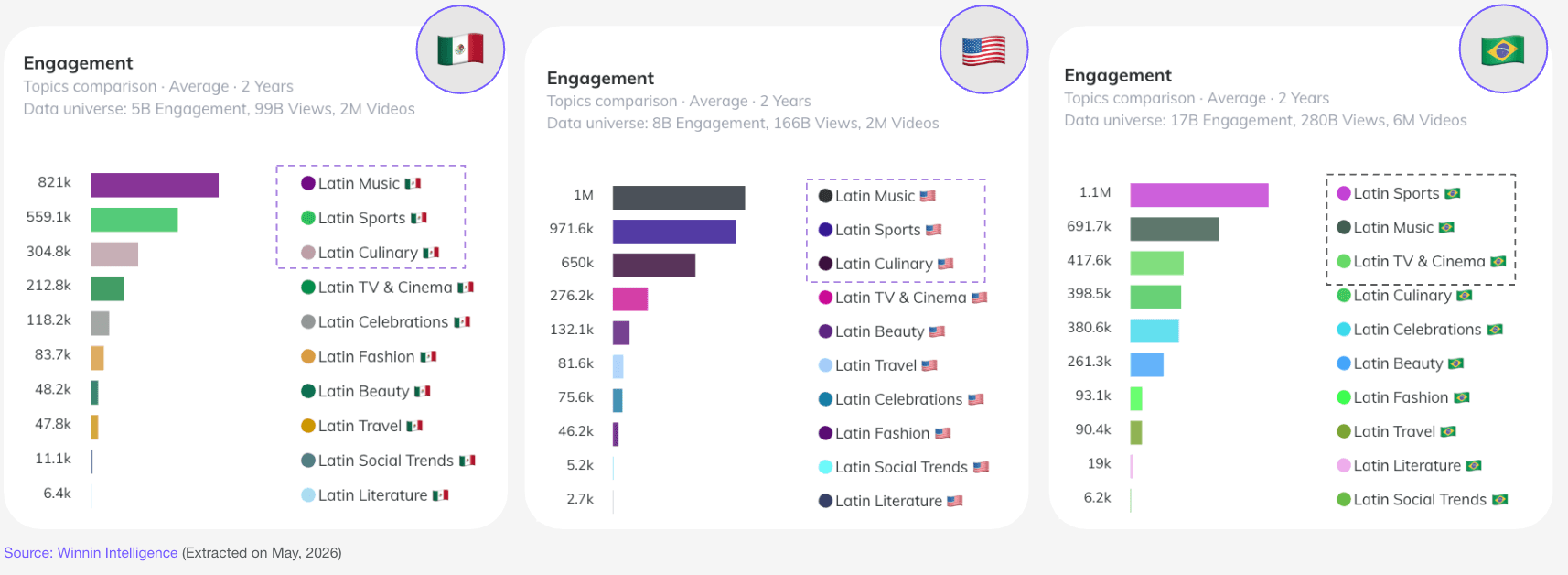
For brands, that's more than an interesting cultural observation. It changes where demand is created. Consumers connect through shared habits, interests, and everyday experiences, not geography alone. As a result, some of the strongest demand spaces for Latin culture are emerging well beyond the region itself.
For marketers still planning around geographic boundaries, that means one thing: you're likely optimizing for markets, while consumers are organizing around culture.
Music Opens the Door. Demand Decides What Comes Next.
Latin music is often the first way global audiences engage with Latin culture, but that's only the entry point. What happens next varies by market, and that's where demand is emerging. While music sparks discovery almost everywhere, the categories that sustain attention differ across regions.
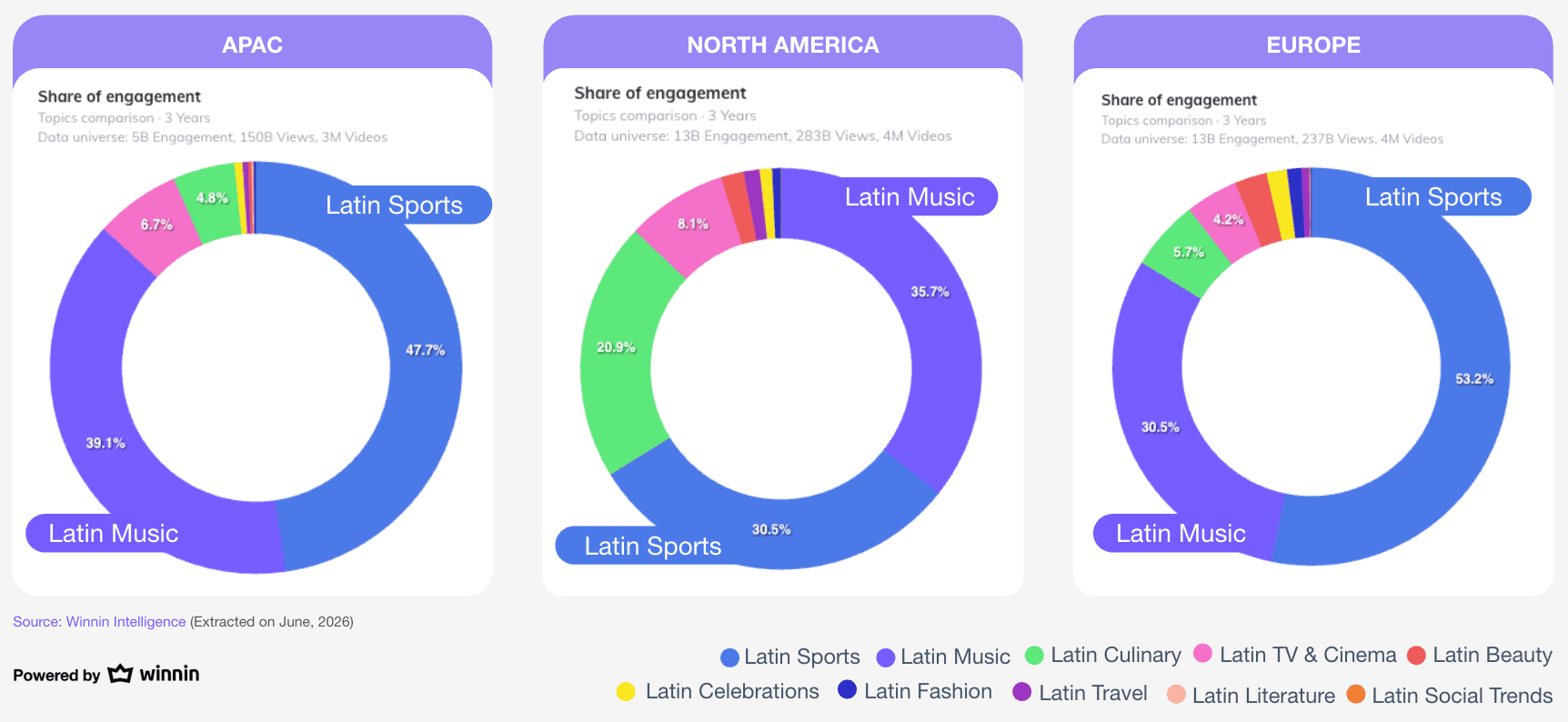
- In Europe, audiences gravitate toward Latin sports.
- In North America, music continues to dominate.
- In APAC, sports and music compete almost equally for attention.
For brands, the implication is clear: scaling a cultural strategy isn't about repeating the same cultural asset globally. It's about understanding which spaces each market opens once audiences step inside.
What the Case Studies Already Proved
The report may put numbers behind the shift, but some brands were already moving in that direction.
When Calvin Klein partnered with Bad Bunny, it didn't try to make him more accessible to a broader audience. His language, his aesthetic, and the cultural codes that made him relevant stayed exactly where they belonged: at the center of the campaign. Nearly a year later, the partnership is still generating organic relevance, sustained by the audience rather than paid media.
Gap made a similar move with Young Miko. Its first fully Spanish-language campaign wasn't designed to make a statement about representation. It reflected something much simpler: the artist speaks Spanish, and that's how the campaign was meant to exist.
Different brands. Different categories. The same instinct. Neither campaign treated Latin culture as an asset to adapt. They started from the culture itself and let that shape the work.
Finding the Demand Space in Your Category
Not every brand should show up in Latin culture the same way. The opportunity depends on where your category naturally fits into the audience's journey, and whether that behavior already exists before your brand enters the conversation.
A few questions can help frame that:
- Is the behavior already there? Are people already engaging with this part of the culture without your brand? If the answer is yes, you're responding to existing demand rather than trying to manufacture it.
- Where does your category enter the journey? Music often opens the door. Sports, fashion, beauty, and food don't necessarily play the same role in every market. Understanding where your category belongs matters more than trying to be everywhere.
- Who's already moving the culture forward? Most of the Latin trends that broke outside Latin America weren't started by brands. They were carried by creators and communities first. The earlier you spot those signals, the more room you have to build relevance before everyone else arrives.
What This Means for Marketing Leaders
Culture is creating demand in places where geography alone wouldn't have predicted it. For marketers, that changes the job.
Instead of asking whether a market is ready, the better question is whether the behavior is already happening, and whether your brand is paying attention to it. By the time a cultural movement becomes obvious, someone else has usually claimed the space.
Download Latin Fever to explore where Latin culture is already creating demand, and where your brand has an opportunity to move first.