
Most marketing conversations about Latin culture start and stop at music. Bad Bunny, J Balvin, Young Miko, reggaeton blasting at parties in Brisbane and Tokyo. What Winnin Intelligence data actually shows is that music is just the entry point — and what it opens up is a much broader demand landscape, one that spreads across categories, regions, and audience profiles that most brands haven't mapped yet.
Over the last 12 months, Latin music drove 8 billion interactions globally, and 1 in every 3 came from outside LATAM. Zoom out to Latin culture as a whole — sports, food, fashion, beauty, TV, celebrations — and the signal gets stronger: average engagement outside LATAM runs 73% higher than within the region itself, across a universe of 49 billion engagements and 15 million videos analyzed by Winnin Intelligence in June 2026.
The demand is already there. What most brands are still missing is the precision to know where to enter.
How brands get in varies by region — and that should change your brief
Music is the most common entry point, but the way each region connects with Latin culture follows its own logic.
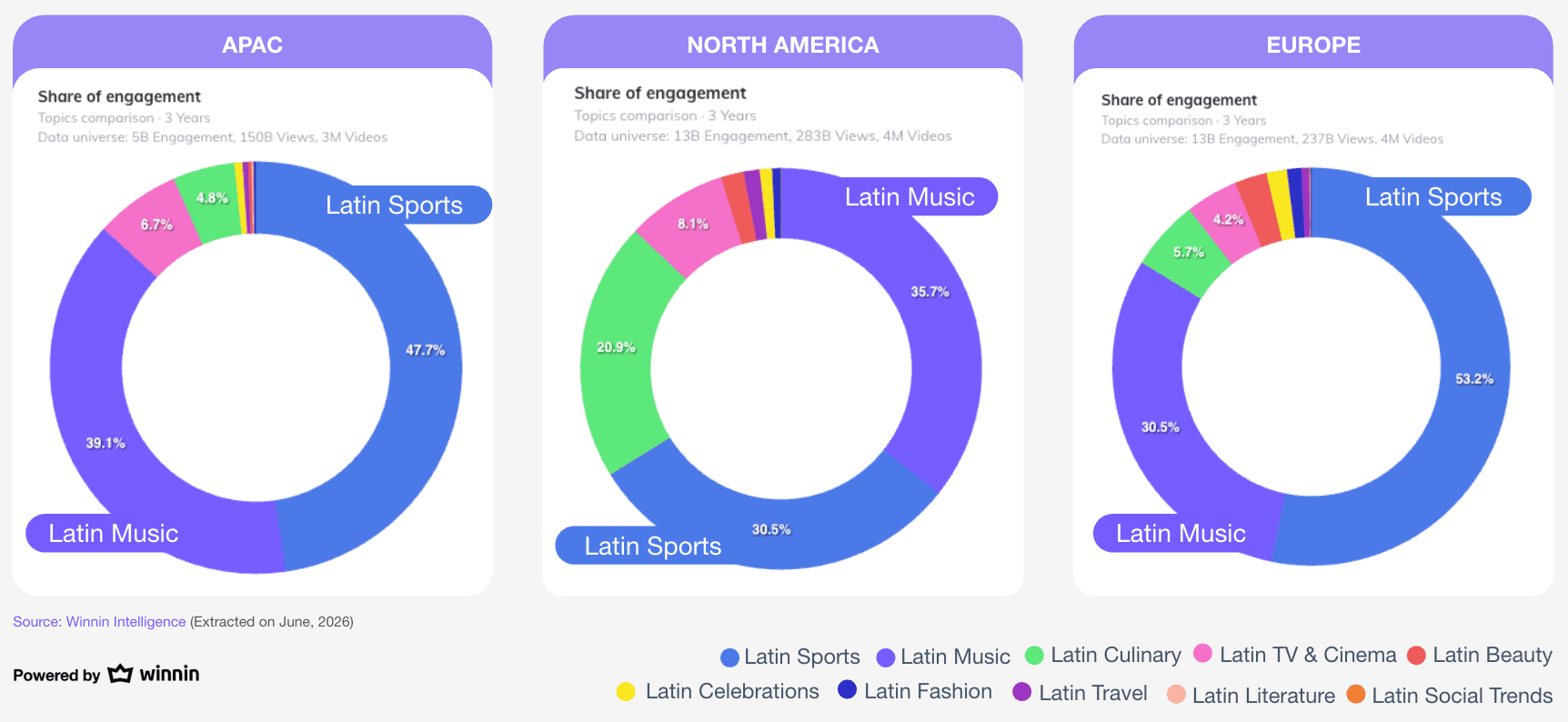
North America shows the most distributed consumption across categories. Music leads with just over a third of total engagement (35.7%), sports comes in close behind (30.5%), and food rounds out the top three (20.9%). It's the most balanced profile of the three regions analyzed — and the one where Latin culture has become a long-standing fixture rather than a trending topic.
Europe comes in through sports. More than half of European engagement with Latin culture comes from that category alone (53.2%), with music in second (30.5%). FC Barcelona, the Champions League, the narratives that turn players into global cultural figures — that's where interest begins, and where it tends to branch out from.
APAC also leads with sports and music, but hides a signal that brands have largely overlooked: a pull toward Latin TV and film that's stronger here than in any other region. Demand spaces with real audiences and almost no brand presence to speak of.
For any brand thinking about activating around Latin culture globally, the question shifts from "should we be part of this conversation" to: which category gives us a real Right to Win, in which region, and with which audience?
Shared language doesn't mean shared demand
There's a common assumption baked into global segmentation strategies that the data challenges head-on: that countries sharing a language or a Latin identity naturally share the same demand spaces.
Mexico and the United States have more overlapping categories — in similar order of relevance — than Mexico and Brazil do. The first two share the same top three: Latin music, Latin sports, and Latin food. Mexico and Brazil diverge as early as the third position.
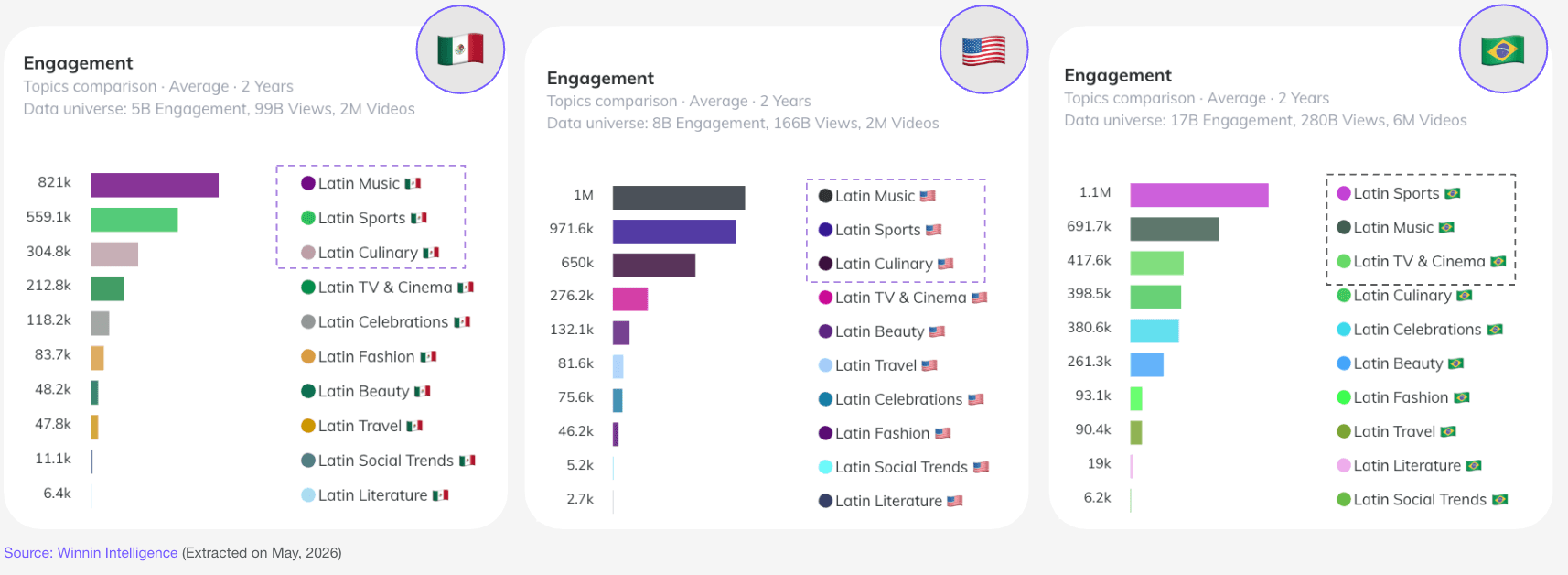
The read is straightforward: geographic proximity predicts cultural behavior more reliably than language. For brands that structure Latin strategies around linguistic blocks or regional identity, that's a flawed premise with real consequences for what gets made and which markets get prioritized.
The audience that's growing fastest
Nearly half of all engagement with international Latin music comes from women (48%), and that share has grown 2.6 percentage points over the past two years. The 25–34 age group is the most represented, with Gen Alpha and Gen Z (ages 13–24) showing consistent growth.
Young non-Latina women are deepening their connection to Latin culture primarily through music, and that behavior is already generating measurable commercial demand. Beauty, fashion, and lifestyle brands that read this early found an audience with an already-formed cultural vocabulary — and a clear appetite for content that respected it.
What separates an activation that actually works
Gap + Young Miko: Gap's first-ever all-Spanish campaign, fronted by Puerto Rican rapper Young Miko, generated over 55 million views and 8 million engagements across 296 videos. What made it work was specificity: the campaign speaks Spanish because Young Miko speaks Spanish. Audiences felt the difference between being reached inside their culture and being targeted by it.
Calvin Klein + Bad Bunny: Nearly a year after launch, the campaign was still generating 800K in relevance — well past the standard paid media window. What kept it circulating was the decision not to soften anything. Features, accent, aesthetic — all of it stayed intact. The audience that already saw Bad Bunny as a reference point for desire found a brand confirming what was already true for them, and kept sharing it long after the campaign officially ended.
In both cases, the brands stepped into territory the audience had already built.
What Demand Intelligence shows from here
Latin Fever has already happened. Demand is consolidated across North America and Europe, and still expanding in APAC. For brands looking to understand where they have real space in this conversation, Winnin's Demand Intelligence maps:
- which categories are seeing engagement growth by region
- audience profiles by demand space
- where brand supply still falls short of existing attention volume
At Winnin, we turn behavioral data like this into cultural intelligence brands can use.
Get in touch to see what it can do for your next move.
Meanwhile, download the full Latin Fever report and see where your category stands.
Download in English | Baixar em Português | Descargar en Español
Data: Winnin Intelligence, extracted May–June 2026. Reference universe for Latin culture overall: 49B engagements, 874B views, 15M videos. Reference universe for Latin music globally: 8B engagements, 166B views, 3M videos.